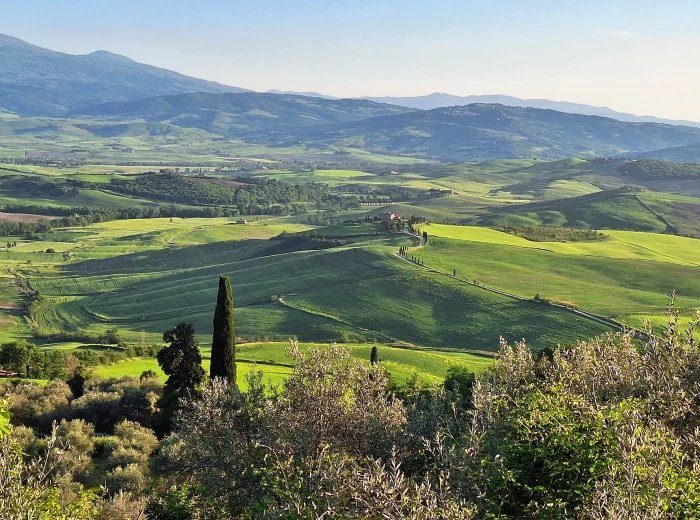
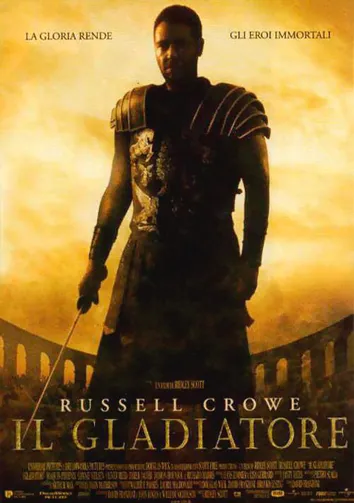
Some people now—even among the residents of Pienza—call it “the Gladiator’s Valley.”
Nothing irreverent or, worse, offensive: the Val d’Orcia has the strength of a protected designation of origin, which the people of Pienza themselves are the first to respect and safeguard..
In that name there is instead a hint of irony, almost a knowing wink, naturally referring to Gladiator, the 2000 film by Ridley Scott, winner of five Academy Awards and starring Russell Crowe, who received one of the Oscars. But it also reflects the powerful attraction that the area just below the town of Pienza exerts on large numbers of visitors, as it served as the setting for several scenes in the film.
Indeed, throughout the year—but especially in the warmer months and at sunset—it is very common to find long lines of cars parked along the SP 18 of Monte Amiata, just a few hundred meters from the center of Pienza, near Podere S. Giuseppe, at the entrance to the footpath leading to the Pieve di Corsignano.
The traffic and crowds, however, are not due to the presence of the magnificent sandstone church dedicated to Saints Vito and Modesto, dating back to the 12th–13th century, in whose baptistery the future Popes Pope Pius II and his nephew Pope Pius III were baptized.
Visitors instead head to that spot—the slope descending from Corsignano toward Podere Terrapile—to admire the landscape where Ridley Scott set one of the most memorable scenes of Gladiator.
In the film, the valley—covered in wheat fields and dotted with cypress trees—is home to the farmhouse of the general Maximus Decimus Meridius, forced to become a gladiator in order to regain his freedom.
The scene possesses a spectacular and emotional power that still fascinates and moves anyone who watches it, almost “compelling” them to visit the site and see whether that place truly exists and carries such evocative strength. The answer is invariably “yes.” And with the wisdom and wit typical of Tuscany, the people of Pienza themselves add: “if it is Gladiator that brings visitors from all over the world to discover and admire the Pieve di Corsignano, then we have achieved something.”
The film was shot in Pienza in June 1999, during two intense weeks of production that, according to reports, brought a considerable number of people to the area, involved in various aspects of the filming. Yet the масштаб of the production, perhaps by design, went largely unnoticed. Scott—already director of Blade Runner—had a very clear vision of the result he wanted to achieve from the setting he had chosen and strongly desired.
A comparison between the film’s images and the real landscape shows that, in post-production, video editing and digital effects were widely used—without taking anything away from the evocative power and dramatic intensity of the scenes.